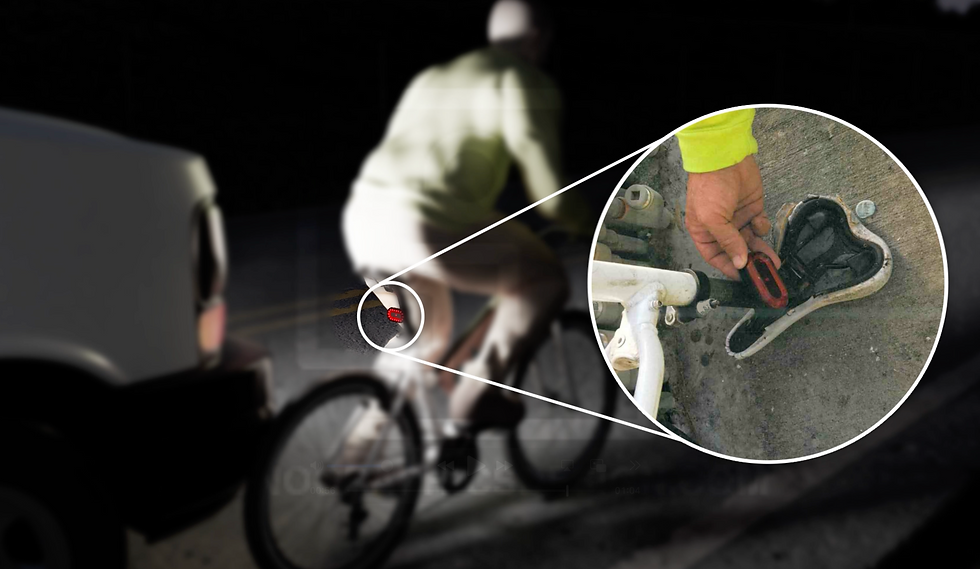
Nighttime Bicycle Collision Reconstruction
In the early hours before dawn, a man was struck by a van while riding his bicycle home from work. The driver reported that he did not see the cyclist due to the dark conditions.
At the center of this case was a critical question: what was actually visible in that moment?
Understanding visibility, perception, and timing became essential to evaluating the events leading up to the collision.
Case Overview
 | Case Type - Nighttime Visibility Case, Motor vehicle accident |
 | Visual Type - Accident Reconstruction |
 | Results - Point of View and Chase Camera animations |
Challenge
This case presented significant limitations in available evidence.
Only a few photos of the client and his bicycle were provided. There were no scene photos or reconstruction data from law enforcement, and the police report itself contained conflicting information about the exact location of impact.
With no definitive measurements or documented scene conditions, key factors such as speed, positioning, and motion had to be carefully estimated using limited inputs, including basic Google reconnaissance and statements from the involved parties.
Visual Strategy
Given that visibility was the central issue, our approach focused on recreating the scene as accurately as possible and presenting it from meaningful perspectives.
We rebuilt the environment using Google aerial imagery and Street View, establishing roadway layout and spatial relationships. From there, we incorporated lighting conditions based on the specific date, time, and weather of the incident.
Additional elements—such as vehicle headlights, bicycle visibility, and surrounding street lighting—were developed using a combination of available references and realistic assumptions.
To fully communicate both perception and sequence, we used a dual-perspective approach:
A driver point-of-view to demonstrate what could be seen in real time
A chase camera perspective to illustrate movement, positioning, and overall context
Our Work
Iconographics produced two forensic animations to support the case:
Point-of-View Animation – Simulating the driver’s perspective leading up to the collision
Chase Camera Animation – Showing the full sequence of events from an external viewpoint
Together, these visuals provided clarity where evidence was limited—helping translate incomplete information into a cohesive, understandable narrative grounded in the available data.

Results
The animations provided a clear framework for understanding the incident despite limited and conflicting evidence.
By illustrating both the driver’s perspective and the full sequence of events, the visuals helped:
- Clarify disputed details regarding location and movement
- Provide context around visibility conditions at the time of the incident
- Support a more cohesive and understandable presentation of the case
This allowed the legal team to present their arguments with greater clarity and confidence, grounded in a visual narrative that aligned with the available evidence.
Testimonial
“When visibility is the central issue, even limited data can be transformed into a powerful visual narrative. The goal isn’t to recreate every detail—it’s to accurately represent what matters most for understanding perception and timing.”
_edited.png)